Market Basics · Chart Academy · Breakouts and failures · Updated 2026-08-30
Breakouts, retests, false breaks and traps
The difference between touching a level and accepting beyond it — plus what a failed break tells you that a clean one does not.
돌파, 리테스트, 가짜 돌파와 함정 — 레벨을 건드리는 것과 그 너머를 받아들이는 것의 차이 — 그리고 실패한 돌파가 깔끔한 돌파보다 더 많은 것을 알려주는 이유.
What it is
A breakout is price moving beyond a meaningful boundary — a level, a range edge, a pattern boundary — and staying there. The staying is the part that matters, and the part most people skip.
How to spot it
A workable breakout checklist:
- There was a meaningful level or pattern boundary in the first place.
- Price closed outside the structure, not merely wicked through it.
- There was follow-through, or a retest that held.
- Participation supported it, where volume data is available and trustworthy.
- It did not immediately fail back inside.
Why people watch it
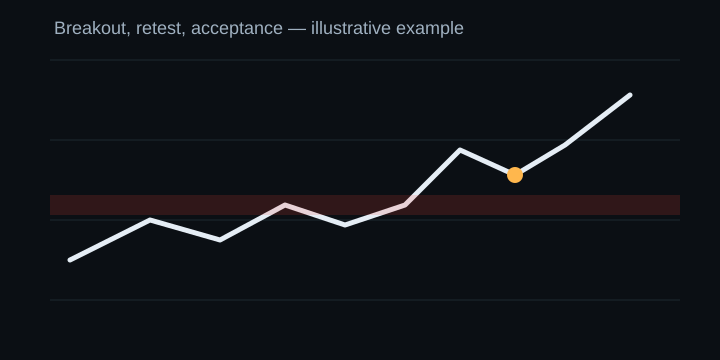
After a break, price often revisits the level. That retest is the most informative moment in the sequence: a clean hold or rejection from the new side strengthens the interpretation, while a deep re-entry back into the old structure weakens it.
Not every break retests, and waiting for one that never comes is its own kind of error. The point of the retest is not that it must happen — it is that when it does happen, it is a second, cheaper opportunity to check whether the level actually changed role.
A false break — price moving beyond a level and then closing back through it — is the same event failing. Bull traps and bear traps are just false breaks named from the point of view of whoever was caught. Liquidity and stop-run language can be a reasonable description of why this happens, but it becomes unfalsifiable storytelling the moment it explains every outcome equally well.
Confirmation
Close beyond the boundary, then acceptance: either follow-through, or a retest that holds. Two of those three is a reasonable bar; a wick alone is not one of them.
Invalidation
Price closing back inside the prior structure. Once that happens the breakout interpretation is finished, and the honest label is a failed break — not 'the breakout is still developing'.
Common mistakes
- Calling a breakout on a wick.
- Treating the first candle outside the level as confirmation rather than as the event that needs confirming.
- Refusing to mark a break as failed because you already published the call.
- Explaining every failed break as a deliberate stop-run — sometimes there were simply more sellers.
Illustrative example
Quick check
1. Price wicks 2% above a range high and closes back inside. What is this?
- A confirmed breakout
- A false break — acceptance beyond the level did not happen
- A retest
- A pennant
Show answer
B. A false break — acceptance beyond the level did not happen
Beyond-the-level is not the same as acceptance beyond the level. The close is what decides which one you saw.
2. Which retest behaviour strengthens a breakout interpretation?
- Price re-entering deep into the old range before recovering
- Price returning to the level and holding or rejecting from the new side
- Price never returning at all
- Price gapping away
Show answer
B. Price returning to the level and holding or rejecting from the new side
A held retest shows the level changed role. A deep re-entry suggests it did not.
3. Why is 'it was a stop-run' a risky default explanation?
- Stop-runs do not exist
- It explains every failed break equally well, so it stops being falsifiable
- It is a proprietary term
- It only applies to crypto
Show answer
B. It explains every failed break equally well, so it stops being falsifiable
An explanation that can never be wrong has stopped being an explanation. Sometimes the honest read is simply that supply exceeded demand.