Market Basics · Chart Academy · Classic chart patterns · Updated 2026-08-30
Classic chart patterns
Triangles, wedges, flags, double tops, head and shoulders, cups, broadening formations and gaps — every one incomplete until its confirmation condition occurs.
고전 차트 패턴 — 삼각형, 쐐기, 깃발, 이중 천장, 헤드앤숄더, 컵, 확산형, 갭 — 모두 확인 조건이 충족되기 전까지는 미완성입니다.
What it is
A chart pattern is a recognisable geometry in price that comes with a stated completion condition. The geometry alone is never the event — the completion is.
GMR names a pattern only when both the geometry and the context fit, and always states what would complete it and what would invalidate it.
How to spot it
Compression patterns — neutral until the break:
- Symmetrical triangle — lower highs and higher lows converging. Direction unknown until it breaks.
- Ascending triangle — flat resistance with rising lows. Often bullish bias, incomplete until resistance breaks and holds.
- Descending triangle — flat support with falling highs. Often bearish bias, incomplete until support breaks and holds.
- Rising wedge — both boundaries rising and converging; often warns of a weakening advance. Confirmation is a lower-boundary break.
- Falling wedge — both boundaries falling and converging; often bullish after upside confirmation.
- Rectangle — repeated horizontal boundaries. Neutral until break; do not call it accumulation or distribution without evidence.
- Flag — requires a prior sharp move (the flagpole) plus a compact counter-trend consolidation. Without the flagpole it is just a small channel.
- Pennant — flagpole plus a short converging consolidation. Distinguish from a longer symmetrical triangle.
Why people watch it
Reversal-shaped patterns, each with a specific completion condition:
- Double top — two meaningful tests of resistance with a swing low between them. It is not complete at the second high; completion normally requires a break below that intervening pivot.
- Double bottom — the mirror image; completion requires a break above the intervening swing high.
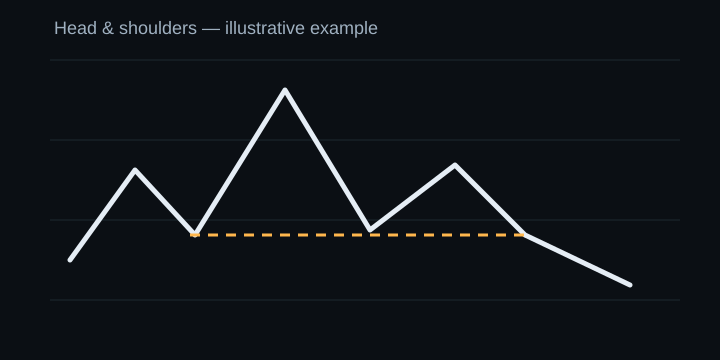
- Head and shoulders — three peaks, the middle highest. The neckline matters far more than visual symmetry. Completion is a neckline break, and necklines are often sloped.
- Inverse head and shoulders — the same structure at a potential bottom.
- Cup and handle — a rounded recovery toward prior resistance followed by a smaller consolidation. A sharp V-bottom is not a cup.
- Broadening formation — higher highs and lower lows, expanding swings. It describes rising disagreement and volatility, not a deterministic direction.
- Gaps — breakaway, continuation and exhaustion contexts. Gap fill is a tendency worth knowing, not a rule; 'all gaps must fill' is false.
Confirmation
Each pattern carries its own condition, and it is always about acceptance rather than touch. Head and shoulders: a neckline break. Double top or bottom: the intervening pivot breaking. Triangle: a break outside the convergence with acceptance. Flag or pennant: flagpole, compact consolidation, then a continuation break.
Invalidation
A pattern is invalidated when price violates the geometry that defined it — a triangle boundary breaking the other way after a signalled break, a head-and-shoulders right shoulder exceeding the head, a flag consolidating so long it stops being compact. State the invalidation before the trade thesis, not after.
Common mistakes
- Declaring a double top at the second high, before the pivot has broken.
- Calling any three bumps a head and shoulders regardless of the neckline.
- Naming a flag with no flagpole.
- Treating an ascending triangle's bullish bias as a forecast rather than a bias that still requires the break.
- Finding a pattern first and then reasoning backwards to justify it.
Illustrative example
Quick check
1. Price makes a second high at the same resistance as the first. Is the double top complete?
- Yes, two touches complete it
- No — completion normally requires a break below the swing low between the highs
- Only if RSI diverges
- Only on a daily chart
Show answer
B. No — completion normally requires a break below the swing low between the highs
Two touches of resistance is a description of resistance. The pattern's completion condition is the intervening pivot breaking.
2. What separates a flag from an ordinary small channel?
- The number of touches
- A prior sharp directional move — the flagpole
- Its colour
- The timeframe
Show answer
B. A prior sharp directional move — the flagpole
Without the flagpole there is no flag. The pattern is defined by the impulse it follows, not by the consolidation alone.
3. A symmetrical triangle is forming. What direction does it predict?
- Upward
- Downward
- Continuation of the prior trend, guaranteed
- None — it is neutral until it breaks
Show answer
D. None — it is neutral until it breaks
Symmetrical triangles are compressions. They often continue the prior trend, but predicting direction before the break is guessing with a diagram attached.